A study will examine how muscles respond to extreme exertion in people with and without neurological impairment
A study will examine how muscles respond to extreme exertion in people with and without neurological impairment
Intense physical exertion triggers a series of physiological reactions at various levels, such as an increased heart rate, rapid breathing and the production of lactic acid. These responses form part of the process of generating the energy required for the muscle to maintain its activity. However, when the exertion is prolonged or very demanding, muscle fatigue and significant physical exhaustion may also occur.
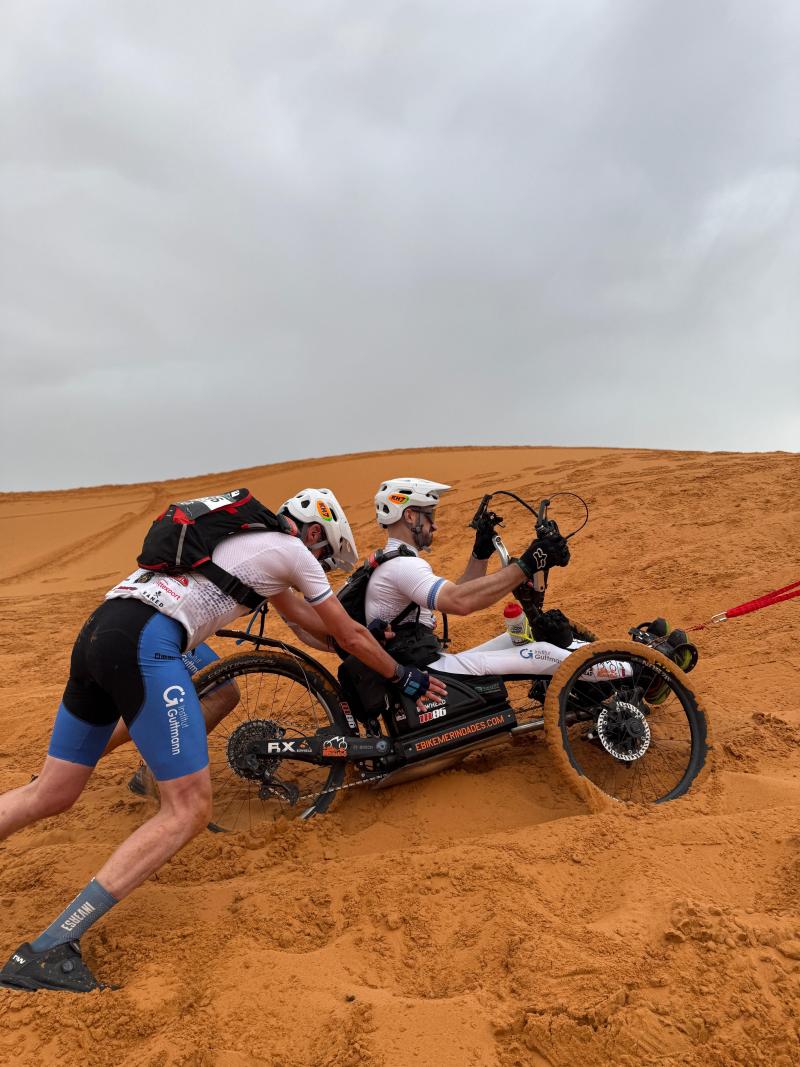
In this context, physiotherapists Miquel Sarrió and Roger Rifà and rehabilitation doctors Jesús Benito and Cristian Figueroa, with the support of the Guttmann Research Institute, will conduct a study to analyse how physiological parameters and muscle bioimpedance vary in people with spinal cord injury and acquired brain injury, and in people without neurological impairment, during an extreme sporting event such as the Titan Desert. This research aims to advance our understanding of the physiological response to extreme exertion and of muscle recovery across different functional profiles, with the aim of obtaining evidence that can help to better personalise training, clinical support and rehabilitation strategies.
Changes in body composition and physiological parameters
The analysis will be carried out on the eight members (five professionals without neurological impairment, one patient with brain damage and two patients with spinal cord injury) of the Guttmann team competing in this year’s Titan Desert: Dr Jesús Benito, Dr Alex del Arco, Miguel Sarrió, Roger Rifà, Alfonso Rubio, Cristian Casals, Iñaki Mújica and Pablo Montoya. The Titan Desert is an extremely demanding cycling race, covering a distance of 600 kilometres with 6,000 metres of elevation gain, spread over five consecutive stages.
The initial hypothesis is that changes in physiological parameters and muscle impedance do not affect people with and without neurological conditions in the same way. Based on this premise, changes in body composition – such as water content, muscle mass, fat mass and basal metabolic rate – and in various physiological parameters will be assessed and compared over the five days of the race.
On the one hand, daily measurements of muscle bioimpedance will be taken using Garmin smartwatches, thanks to a joint collaboration agreement, which will record indicators as body fat percentage and weight, muscle mass and distribution, body water, body mass index, basal metabolic rate and impedance value. At the same time, participants will be monitored 24 hours a day using a wearable device, which will record indicators such as heart rate, oxygen saturation, calories burned, minutes of intensity, heart rate variability, sleep quality, recovery level and stress levels.
Through this research, Guttmann continues to advance the generation of knowledge applied to neurorehabilitation and adapted sport. Furthermore, this study falls within a research field that is still very much in its infancy, as the analysis of the impact of intense and sustained exercise on people with neurological conditions is currently a largely unexplored area.